How to Store Gasoline Long Term: Cans, Stabilizer and Safe Spots
How to store gasoline long term: approved cans, stabilizer, a safe place to keep them, how long gas lasts, and how to fill and pour without spills or fires.
 By Mike Dawson
9 min read
BLUFBottom line up front
Store gasoline in approved, tightly sealed cans, filled to about 95 percent, in a shed or detached garage away from the house and any flame. Add stabilizer at fill-up and rotate the fuel into your car. Untreated gas is usually good for a few months. Treated gas lasts much longer.
- Gas pumps need electricity, so the fuel in your cans is all you have in a long outage.
- Rule of thumb: untreated gas stays good about 3-6 months. Stabilizer makers claim up to 24 months. Check the label.
- Fill cans on the ground, never in a truck bed or trunk, and keep the nozzle touching the can.
- Store cans outdoors or in a detached shed or garage, never in the living space. Check local fire code for limits.
- Never run a generator indoors or in a garage, and let it cool before refuelling.
Draw list What to get, and why
| Item | Why | Rough cost |
|---|---|---|
| UL-listed or approved gas cans (5 gal) | Built to hold fuel and vent safely | About $15-35 each |
| Fuel stabilizer | Slows gas going stale; the usual dose is 1 oz per 2.5 gal | About $5-15 per bottle |
| Replacement spouts (match your can brand) | Old spouts clog and leak | About $5-15 |
| Funnel with a screen | Keeps debris and water out of the tank | About $5-10 |
| Battery-powered CO alarm | Needed any time an engine runs near the house | About $25-40 |
| Small ABC fire extinguisher | For the shed or garage where fuel is kept | About $20-40 |
Rather watch it?
I cover this in a video: 13 Items That Disappear From Walmart in the First 5 Hours of Grid Collapse.
Plays from YouTube when you click it.
When the power goes out, gas stations go with it. The fuel is in tanks under the concrete, but the pumps that bring it up need electricity. A car on empty is a very large paperweight.
If you want to know how to store gasoline long term, the answer comes down to four things. Use the right can. Treat the fuel. Keep it somewhere safe. Rotate it. Do those and your cans become a real backup for the car, a generator or a chainsaw.
This is safety information, not a license to stockpile. Gasoline is dangerous, and local rules can limit how much you keep at home. Read the whole page before you buy cans.
Why gas stations stop working
Pumps run on electricity. Some stations have generators or transfer switches, but plenty do not. In a wide outage, lines form fast and stations run dry. The panic buy is a gas can, which is why it shows up on my list of what sells out first in an emergency.
Buy cans on a quiet weekend. Fill them before a storm, not after.
How long does gasoline last?
Plain gasoline does not keep forever. As a rule of thumb, plan on about 3-6 months for untreated pump gas, and shorter in a hot, vented tank. Sources differ, and I could not find one official figure.
Most pump gas is E10, which is 10 percent ethanol (US Department of Energy). Ethanol pulls water out of the air. If enough water gets in, the fuel can separate into layers, and the engine will not run on it. A National Renewable Energy Laboratory study of small-engine tanks found that gasoline goes stale before E10 takes up enough water to separate, according to a summary in Biofuels Digest.
Stale gas gums up carburetors and small engines. Cars run rough, then stall at the wrong time.
Does stabilizer work?
Yes, within limits. Fuel stabilizer is an antioxidant additive that slows the chemical aging of gas. A boating magazine’s test, BoatingLAB’s stabilizer tests, found that treatments can slow the process. It also found little difference between brands in preventing phase separation.
The common dose is 1 ounce per 2.5 gallons, and the maker claims up to 24 months of freshness per NAPA’s guide. Treat that as the manufacturer’s claim, not a promise. Follow the label, and use it with fresh fuel. For storage past a year, some sellers suggest a higher dose, so read the bottle.
Tip: Add the stabilizer to the empty can first, then fill it. The fuel mixes as it pours. Run the treated gas through the engine for a few minutes so it reaches the carburetor.
Pick the right can
Use only approved cans: UL-listed plastic or metal containers made for fuel. Do not use milk jugs, glass jars or old paint cans.
A federal rule changed gas cans. In 2007 the EPA adopted standards for portable fuel containers, modeled on California’s rules, and they took effect in 2009 (CARB resolution). The goal was less evaporation and fewer spills. The result is a self-sealing spout that many people fight with.
How to use the spout
Most of these spouts work the same way. Check your can’s instructions, because designs vary.
- Set the can on the ground.
- Press the spout against the tank opening and push down.
- Pour. The spout opens when pressed and seals when you lift it.
A clogged or damaged spout is the common complaint. Replace it rather than defeating it. A cut-off spout takes away the safety feature.
Sizes and numbers
Five gallon cans are the usual size. A full one weighs about 30-35 pounds, since gasoline is about 6 pounds per gallon. That is a rule of thumb, not a spec. Smaller 1 to 2 gallon cans are easier to carry and pour.
How to fill a gas can without starting a fire
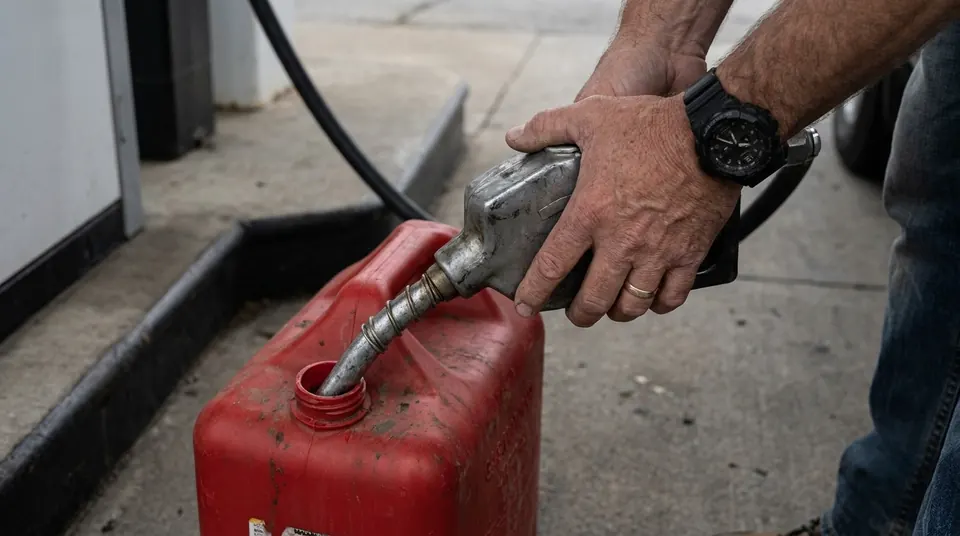
Static electricity can ignite gasoline vapor. Filling a can in a truck bed or trunk is how it happens. The plastic liner insulates the can, and the charge has no path out. This was the finding of a NIOSH bulletin on fires from filling gas cans in pickups and cars.
The Army’s safety guidance, in Respect the dangers of gasoline, says to:
- use only approved plastic or metal containers;
- fill them on the ground, away from vehicles and traffic, never in a truck bed or trunk;
- keep the nozzle touching the can while filling;
- fill slowly and stop at about 90 to 95 percent of capacity, to leave room for expansion;
- seal them tightly and carry them upright, in a ventilated space, never in a hot vehicle.
Safety: Never use gasoline for anything but fuel. Do not use it to clean parts, start a fire or substitute for kerosene or lighter fluid. Never siphon with your mouth. Never use water on a gasoline fire.
Where to store gas cans at home
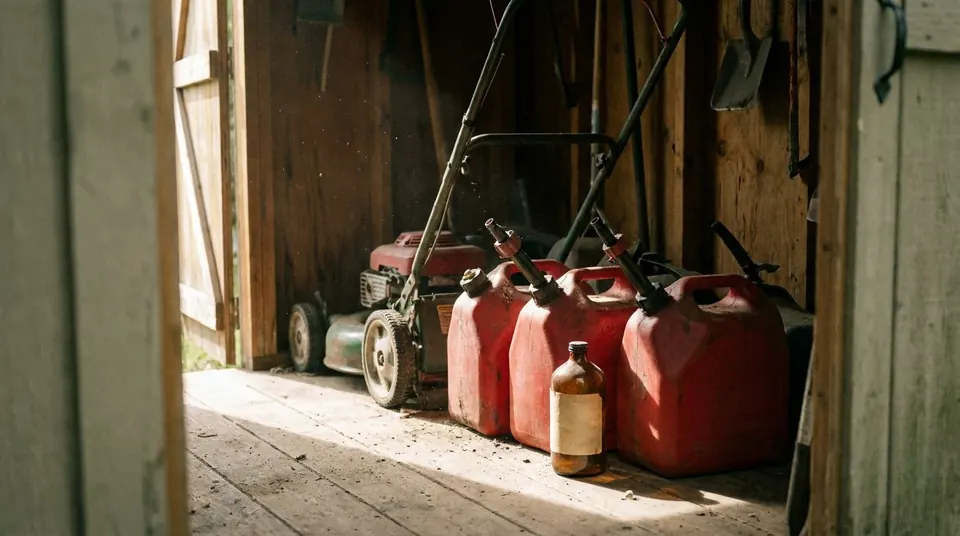
Store them outdoors, or in a detached garage or shed. Keep them away from children, living spaces and any heat or spark source. That means no water heaters, pilot lights, furnaces or welders nearby. The Army’s guidance says the same.
An attached garage is a gray area. Fumes can drift into the house. If an attached garage is your only choice, keep the amount small and check your local rules.
How much gas can I store at home?
There is no single national number. Local fire codes set limits, and they vary by town and building type. Call your fire department or check your local code before you store more than a few cans. Keep only the minimum you need, and never store fuel in a vehicle.
Other tips:
- Keep cans out of direct sun and off bare concrete if you can. A board or shelf is fine.
- Keep a fire extinguisher by the door of the shed.
- Label each can with the fill date and stabilizer.
- Do not stack cans so they can tip.
Rotate it into the car
Stored fuel only helps if you use it. Every few months, pour the oldest can into your car and refill the can with fresh gas and stabilizer. Do this on a cool morning, outdoors, with the engine off.
A simple routine works. Fill the can, add stabilizer, write the date, store it. When the date is six months back, run it through the car and start again. Keep the car’s tank at least half full in storm season.
A simple storage plan for a household
Here is a plan that fits a normal family. It is an example, not a rule.
- Own two or three 5 gallon cans, so you can rotate one while the others sit.
- Date each can with a marker, and note the stabilizer.
- Use the oldest can first, every spring and fall.
- Keep the car’s tank at least half full.
- Keep the cans together on one shelf, so you can see them and count them.
This gives you a small, rotating reserve rather than a pile of aging fuel. Match the amount to what you can store legally, and to what you will actually burn. A reserve of 10 or 15 gallons that you rotate is worth more than 40 gallons nobody touches for three years.
Diesel, briefly
Diesel keeps longer than gas, but not forever. Vendor sources say about 12 months at a cool temperature, and shorter in heat. These are rule-of-thumb figures, not an official number. Water is the main problem, because it feeds microbes that form sludge. Keep diesel containers sealed and out of the heat, and use a biocide if you store it for a long time.
Generator safety
If the gas is for a generator, the fuel is only half the job. Carbon monoxide is the other half.
CDC’s rules are clear. Run a generator only outdoors, more than 20 feet from windows, doors and vents. Never run one in a home or garage, even with the doors open. Use a battery-powered or battery-backup CO detector. Plug-in alarms with no battery go dead with the grid.
Ready.gov adds: let the generator cool before refuelling. Fuel spilled on hot parts can ignite. Many local agencies suggest waiting about 20 minutes. That is guidance, not a universal number.
Keep the fuel can well away from the running unit when you refill. Use a funnel. Wipe up spills, and let fumes clear before you start the engine.
Safety: Carbon monoxide has no smell and no warning. Symptoms look like the flu: headache, dizziness, nausea. People who are asleep can die before they feel anything.
What to do this weekend
- Buy two or three approved cans, and replace any old spouts.
- Buy fuel stabilizer and read the label for the dose.
- Pick a spot outdoors or in a detached shed, away from heat.
- Fill on the ground, label and date each can.
- Check your local fire code for storage limits.
- Put a battery CO alarm in the house if you plan to run a generator.
- Set a phone reminder to rotate the fuel into the car.
For other fuel, see propane exchange vs refill, and for lighting without gasoline, see my guide to kerosene lantern safety.
Frequently asked questions
How long does gasoline last in a gas can?
As a rule of thumb, untreated pump gas stays good for about 3 to 6 months. Heat, humidity and a vented can shorten that. With stabilizer, makers claim up to 24 months, but results vary, so rotate it and trust your nose.
How long does gas last with stabilizer?
Stabilizer makers such as STA-BIL claim up to 24 months with the right dose, usually 1 ounce per 2.5 gallons. Independent testing shows stabilizers can slow aging but do not stop it. Store the can sealed, cool and mostly full.
How much gas can I store at home?
There is no one national limit. Local fire codes decide, and they differ by town. Call your fire department or check your code. Keep only the minimum you need, in approved cans, outside the living space.
Can I store gas in my garage?
A detached garage or shed is better. Fumes can drift from an attached garage into the house. Keep cans away from heat and sparks such as a water heater, and check local limits. Never store gas in a vehicle.
Why shouldn’t I fill a gas can in my truck bed?
The bed liner insulates the can, so static electricity can’t discharge. A spark at the nozzle can ignite the vapors. Set the can on the ground and keep the nozzle touching it, as NIOSH and the Army advise.
Is it safe to put old gas in my car?
Mildly aged gas is often burned off by mixing it into a mostly full tank, but check your owner’s manual first. Do not use fuel that smells sour, looks cloudy or has water in it. Take bad fuel to a hazardous waste site. Never pour it on the ground or down a drain.
Sources
- US Army: Respect the dangers of gasoline
- NIOSH via eLCOSH: Fire hazard from filling portable gas cans in pickups and cars
- CDC: Carbon monoxide
- Ready.gov: Power outages
- US DOE Alternative Fuels Data Center: Ethanol blends
- Biofuels Digest: NREL study on gasoline and ethanol phase separation
- BoatingLAB: Fuel stabilizers tested
- NAPA Know How: How to use fuel stabilizer
- California Air Resources Board: portable fuel container rule
General information, not medical or professional advice. In an emergency, call 911 and follow official instructions. Disclaimer.