How to Clean a Wound: Irrigation With Water and a Syringe
How to clean a wound at home: stop the bleeding, flush it with clean water and a big syringe, use iodine on the skin only, and know when to see a doctor.
 By Mike Dawson
11 min read
BLUFBottom line up front
Stop the bleeding with direct pressure first. Then flush the wound hard with clean running or syringe-driven water until no dirt is left. Wash the skin around it, cover it with a clean dressing, and watch for infection. See a doctor for deep, dirty or bite wounds.
- Stop the bleeding first. Irrigate only once it has slowed or stopped.
- Pressure matters more than the liquid. A 35-60 mL syringe flushes out dirt that a splash leaves behind.
- Tap water that is safe to drink is an accepted wound rinse. If your water is not safe, boil it for 1 minute and let it cool.
- Use povidone-iodine on the skin around a wound, not poured into it. Never use the soap scrub type in an open wound.
- Deep wounds, bites, punctures, wounds with gaping edges and any spreading redness need a doctor.
Draw list What to get, and why
| Item | Why | Rough cost |
|---|---|---|
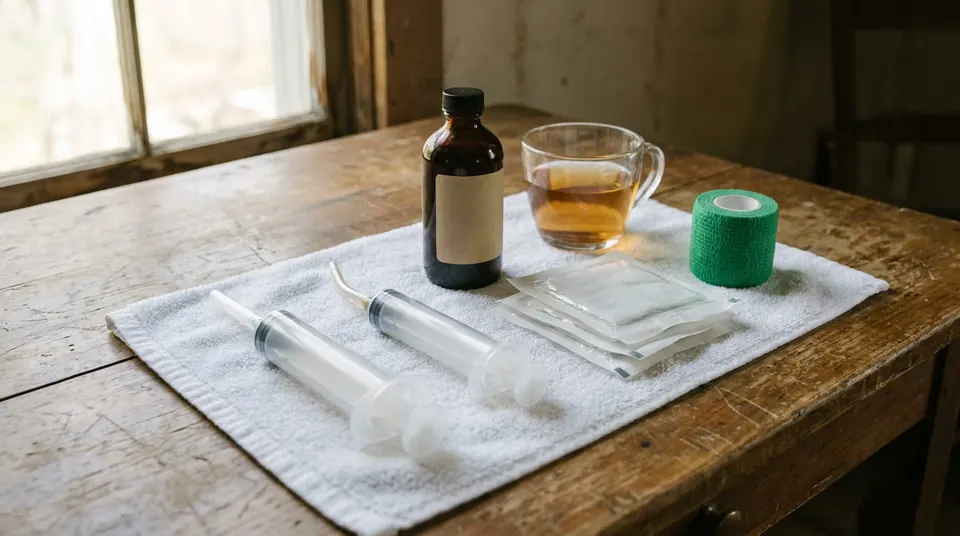
| Irrigation syringe, 35-60 mL, no needle | Gives the pressure that lifts dirt out of the wound | About $1-5 each |
| Povidone-iodine 10% solution (not the scrub) | For the skin around the wound, not inside it | A few dollars to about $15 |
| Sterile gauze pads and non-stick dressings | Cover the wound after cleaning | A few dollars per box |
| Self-adhesive vet wrap | Holds the dressing in place, sticks to itself, tears by hand | A few dollars per roll |
| Clean water, 1 gallon set aside | Rinse supply that is safe to drink, so you do not use water you doubt | About $1-2 |
| Disposable gloves and eye protection | Blood and spray protection for the person helping | A few dollars |
Rather watch it?
I cover this in a video: 9 Cheap Items at Tractor Supply That Veterans Hoard Before Anyone Else.
Plays from YouTube when you click it.
Note: This article is information, not medical care and not training. It does not replace a doctor, an emergency room or a hands-on class. For a serious wound, get real medical care. If bleeding is heavy and will not stop, call 911 and use a tourniquet or pressure dressing as you were trained.
Knowing how to clean a wound is the cheapest first-aid skill you can learn. Most small cuts, scrapes and punctures that go bad do so because dirt stayed in them. Get the dirt out early and well, and the wound has a far better chance of healing without trouble.
It matters more now for a plain reason. The livestock antibiotics people used to grab at the farm store are no longer on the open shelf. In June 2023 the FDA finished moving the last over-the-counter medically important animal antibiotics to prescription, under a program called GFI #263. If you cannot count on a cure, you put your effort into prevention. For wounds, that means cleaning them well.
This guide covers the steps, what to use, and when a home kit is not enough.
Step 1: stop the bleeding first
Do not irrigate a wound that is still bleeding hard. Merck’s professional manual says that getting bleeding under control must come before irrigation, because flushing can wash away the clot.
- Wash your hands if you can, and put on gloves.
- Press a clean cloth or gauze firmly on the wound with your hand. Direct pressure is the main method.
- Keep pressing without peeking. Many cuts slow down within several minutes.
If blood spurts, soaks through the cloth, or does not slow after about 10 minutes of firm pressure, this is no longer a cleaning job. Call 911. Packing and pressure dressings are covered in my guide to the Israeli bandage, and a limb that will not stop bleeding may need a tourniquet. See how to spot a fake tourniquet before you buy one.
Step 2: how to clean a wound by irrigating it with a syringe
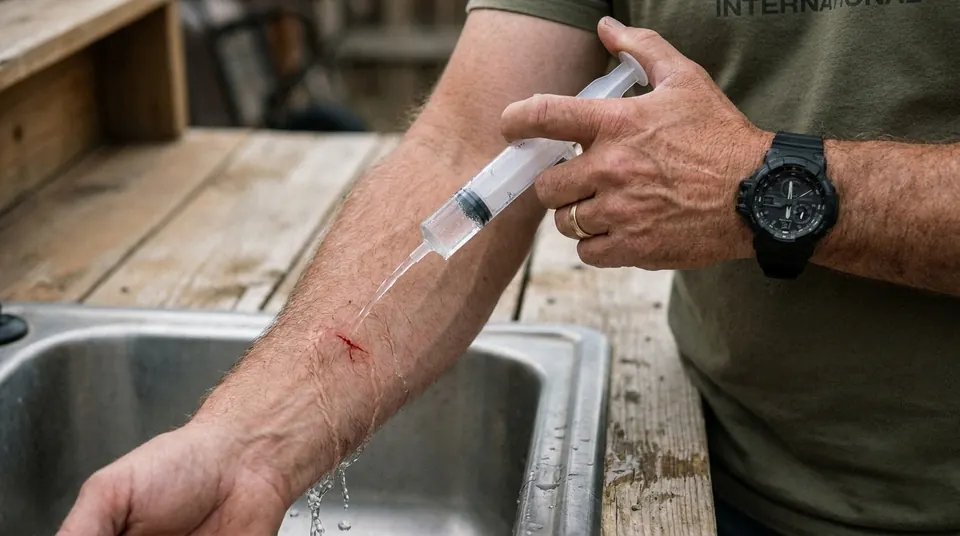
Irrigation is flushing the wound with a stream of liquid under pressure. A quick splash under the faucet runs off the top of the wound. Dirt and germs sit down inside it, and it takes pressure to lift them out.
A large syringe with no needle solves that. A curved-tip syringe is handy for getting into a deep cut.
How to do it
- Fill a 35-60 mL syringe with clean water.
- Hold the tip close to the wound, but do not touch the wound with it.
- Push the plunger firmly, using both thumbs if you need to. You want a strong stream, not a trickle.
- Tilt the wound so the dirty water runs away from it, not into it.
- Refill and repeat. Keep going until the wound looks clean, then give it a few more flushes.
- Wear eye protection. The water splashes back.
Clinicians give a guide for how much. Merck says typical volume is 50 to 100 mL per centimeter of wound length, and 30 to 50 mL per centimeter for a relatively clean wound. A 2017 American Family Physician review puts the target pressure at about 5 to 8 psi, which a 35 mL syringe pushed through a needle can reach. A plain syringe is gentler, and that is fine for home use.
Tip: Buy several syringes. They are cheap and light. Keep two in the house kit and two in the car.
What about scrubbing?
Merck says to scrub only if irrigation fails to remove visible particles, and to scrub gently, since scrubbing can damage tissue. At home, treat stuck grit as a sign that you need a doctor. Do not dig at a wound with tweezers or a needle.
Can you clean a wound with tap water?
Yes, if the water is safe to drink. Merck states that using tap water is not associated with an increased risk of infection and lists clean, potable water as a permitted substitute for sterile saline.
The Cochrane review “Water for wound cleansing” by Fernandez and colleagues is the main research here. Its older versions found tap water lowered infection rates in acute adult wounds compared with saline. The 2022 update is more cautious. It says the effect on infection and healing is uncertain, because the studies are small. So the fair summary is this: tap water appears to work at least as well as saline, but the evidence is thin, and no study says you need sterile fluid.
If your tap water is not safe to drink, as in a boil-water notice or a flood, do not use it on a wound. The CDC says to bring water to a rolling boil for 1 minute, or 3 minutes above 6,500 feet. Let it cool all the way first. Boiling water on a wound will scald it.
Water stored in containers works too, as long as you treat it first. My guide to stock tank water storage covers how.
Step 3: povidone-iodine, and what not to do with it
Povidone-iodine is the brown solution surgeons paint on skin. The farm-store bottle is often the same 10% strength as the drugstore kind, in a bigger size for less money.
How to use it:
- On the skin around the wound. Paint it on the edges, working outward from the wound. Merck lists povidone-iodine among the antiseptics for the skin around a wound.
- Not poured into a deep wound. Merck warns not to put cleansing agents directly into a wound, because many are toxic to tissue. The research on iodine in wounds is mixed. Lab studies show diluted solutions can still harm healing cells, though some reviews find no consistent harm in living patients.
- The “weak tea” rinse. Some people dilute it with clean water until it looks like weak tea and use that to rinse a dirty scrape. That is a rule of thumb from farm and field use, not a measured dose, and it is not a medical recommendation. Plain clean water works, so if you are unsure, use water.
- Read the label. Buy the plain solution. Skip the “scrub” version, which has soap in it and is made for washing skin before surgery. You do not want soap in an open wound.
- Allergy and health cautions. If iodine has ever given someone a rash, use plain water. Check the label, and ask a doctor before use if you have a thyroid condition or are pregnant.
Keep the bottle in the dark, out of the sun. Iodine is also not for deep wounds, animal bites or serious burns. Those need a doctor.
Step 4: dress and cover the wound
After cleaning, pat the skin dry around it and cover the wound.
- Use a clean, non-stick dressing or sterile gauze. Merck notes that the layer touching the wound should stay moist and not dry onto it.
- Hold it in place with self-adhesive vet wrap or a bandage.
- Change the dressing daily, or sooner if it gets wet or dirty.
Vet wrap sticks to itself, not to skin or hair. It holds a dressing through sweat and rain, and you can tear it by hand. The danger is that it springs back and keeps squeezing. Never wrap it tight. Stretch it only a little, overlap each turn by about half, and then check the fingers or toes past the wrap. They should stay pink and warm. If they turn pale, blue, cold or tingly, take it off and redo it looser. Check again later, because a hurt limb swells.
Safety: A wrap that is too tight can cut off blood flow. Check circulation after you apply it and again a few hours later.
Tetanus: check your booster
Dirt, soil and punctures raise the risk of tetanus. The CDC’s guidance for people who finished their primary vaccine series is:
| Wound type | Booster needed if last dose was |
|---|---|
| Clean, minor | 10 or more years ago |
| Anything else (dirty, puncture, bite, crush, burn) | 5 or more years ago |
If your vaccine history is unknown or incomplete, call a doctor. The CDC says wounds should be cleaned and debrided, and that antibiotics are not a way to prevent tetanus. Know your last booster date today. In an outage, a clinic may be hard to reach.
Signs of infection
Check the wound daily. Get medical help for any of these:
- redness that spreads outward from the wound;
- red streaks running up the limb;
- pus or foul-smelling drainage;
- more pain, swelling or warmth after the first day or two;
- fever of 100.4°F (38°C) or higher.
To be fair, a syringe will not cure an infection that has already set in. If you see these signs, you need real treatment from a doctor, urgent care or an emergency room. Do not try to treat it with leftover or animal antibiotics. They are not meant for people, and the right drug and dose depend on the case. If the clinic is far away, call a nurse line or telehealth service.
When to see a doctor
Home cleaning is for small, simple wounds. See a doctor, and do not rely on this article, for any of these:
- bleeding that does not stop after 10 minutes of firm pressure;
- wounds with gaping edges, or deeper than about a quarter inch (0.6 cm);
- fat, muscle, tendon or bone showing;
- bites from an animal or person;
- punctures from nails, tools, fishhooks or similar;
- wounds with embedded grit or glass that irrigation did not clear;
- wounds on the face, hands, genitals or over a joint;
- any wound with the infection signs above;
- any wound where you are unsure.
The size and depth numbers are common clinic guidance and vary a little by source. When in doubt, go. A doctor can close a wound properly and check your tetanus status.
Stitching works best within hours, so do not wait to see how it looks tomorrow.
Why the army learned this the hard way
Army lesson: In World War I, before penicillin, army surgeons worked out that thorough, repeated washing saved limbs. French surgeon Alexis Carrel and English chemist Henry Dakin developed a system in a hospital near the front around 1916. It used frequent irrigation of the wound with a dilute bleach solution. It is called Dakin’s solution today. Do not mix this at home. The lesson is the washing: do it early, do it thoroughly and do it again.
Military medicine still stresses the same basics. Control the bleeding, clean the wound and keep it covered. For a gear list built on that idea, see my guide to what to buy at an army surplus store. The cheap farm-store version is on my list of Tractor Supply prepping items.
Get trained
Reading is not enough. Take a hands-on class. The Red Cross runs first aid and bleeding control courses that meet Stop the Bleed standards. A few hours with an instructor will teach you more than any article.
What to do this weekend
- Buy 3-4 large syringes (35-60 mL). Keep two at home and two in the car.
- Buy plain povidone-iodine 10%, not the scrub version.
- Put together a kit: gloves, gauze, non-stick pads, vet wrap and tape.
- Set aside a gallon of drinking water for rinsing.
- Find your last tetanus booster date and write it on the kit.
- Sign up for a first aid or Stop the Bleed class.
Frequently asked questions
Can you clean a wound with tap water?
Yes, if the water is safe to drink. Merck’s manual says tap water is not linked to a higher infection risk and accepts clean potable water in place of sterile saline. The Cochrane review calls the evidence uncertain but finds no sign that tap water is worse. If your water is not safe, boil it for 1 minute and cool it first.
How do you irrigate a wound at home?
Stop the bleeding first. Then fill a 35-60 mL syringe with clean water, hold the tip close to the wound, and push hard. Tilt the wound so the water runs away. Repeat until it looks clean. Wear eye protection, then dress and cover the wound. See a doctor for deep, dirty or bite wounds.
Is povidone iodine good for cleaning wounds?
It is a good skin antiseptic. Paint it on the skin around a wound. Do not pour it deep into a wound, since many cleaning agents can harm tissue. Use the plain solution, not the scrub with soap. Skip it if you are allergic, and ask a doctor first if you have a thyroid condition or are pregnant.
How do you clean a deep cut at home?
You should not rely on home care for a deep cut. If it is deeper than about a quarter inch, gaping, or shows fat, tendon or bone, get medical care. While you get there, control bleeding with firm pressure and cover the wound with a clean dressing. Irrigation is for small wounds, or as a first step before care.
What are the signs a wound is infected?
Spreading redness, red streaks, pus or bad-smelling drainage, rising pain or swelling, warmth and fever of 100.4°F or higher. If you see any of these, get medical care. Cleaning does not cure an infection that has already started, and animal antibiotics are not a safe substitute.
Do I need a tetanus shot for a cut?
The CDC says that if you have finished the primary series, a clean, minor wound needs a booster when the last dose was 10 or more years ago. Other wounds, such as punctures, bites and dirty wounds, need one at 5 or more years. If you are unsure of your history, ask a doctor.
Sources
- Merck Manual Professional: How To Cleanse, Irrigate, Debride, and Dress Wounds
- American Family Physician (2017), wound care review, p. 628
- Cochrane: Water for wound cleansing (2022 update)
- Cochrane: Water for wound cleansing (2008 version)
- CDC: Clinical Guidance for Wound Management to Prevent Tetanus
- CDC: Drinking Water Advisories, an Overview
- FDA: Transition of OTC medically important antimicrobials for animals to prescription status
- Dakin’s solution and the Carrel-Dakin method: historical review (PMC)
- American Red Cross: Stop the Bleed Day
General information, not medical or professional advice. It does not replace hands-on training: take a Stop the Bleed or first aid class, and get real medical care for serious wounds. In an emergency, call 911 and follow official instructions. Disclaimer.