H2OWater
Stock Tank Water Storage: A 100-Gallon Backup for Under $200
A 100-gallon stock tank holds about 835 lb of water, enough for four people for roughly 25 days. Here is how to fill, cover, treat and place it safely.
 By Mike Dawson
10 min read
BLUFBottom line up front
A 100-gallon stock tank holds about 835 lb of water. At FEMA’s minimum of 1 gallon per person per day, that is 25 days for a family of four. Fill it from a hose, cover it, set it on level ground, and treat the water before anyone drinks it.
- Water weighs 8.34 lb per gallon, so a full 100-gallon tank is about 835 lb. Never put one on a deck.
- FEMA and Ready.gov say store at least 1 gallon per person per day. Hot weather can double that.
- Stock tanks are sold for animals, not labelled for drinking. Filter, then boil or bleach the water first.
- Keep the tank covered. Standing water breeds mosquitoes, and an open tank is a drowning risk.
- Roof runoff and old tank water are best used for flushing the toilet and watering the garden.
Draw list What to get, and why
| Item | Why | Rough cost |
|---|---|---|
| Stock tank, about 100 gal or larger | The bulk storage itself. A hose fills it free. | Roughly $100-200 for galvanized or poly, by size |
| Plywood or fitted lid, plus weights | Keeps out mosquitoes, kids, pets and wind | About $20-40 |
| Unscented household bleach | Treats the water you drink (EPA dose table) | A few dollars a jug |
| Coffee filters or a clean cloth | Strains cloudy water before treatment | A few dollars |
| Food-grade bucket with lid and a dipper | Clean way to draw water without dunking hands | About $5-15 |
| Gravel, pavers or a concrete pad | A level, firm base that can carry the weight | Free to about $50 |
Rather watch it?
I cover this in a video: 9 Cheap Items at Tractor Supply That Veterans Hoard Before Anyone Else.
Plays from YouTube when you click it.
Most families have a water plan that amounts to a few cases of bottles and some hope. Stock tank water storage is a better plan, and it comes from the farm aisle. It is a big open tub made for cattle, and it holds more water than most homes have stored, water heater included.
I’m a veteran, and the army drills one thing into you early: water comes first. A person can go weeks without food, but only days without water. So the question is simple. Where will your household’s water come from when the taps stop?
This article covers it from start to finish: sizes, how long a tank lasts, how to fill it, how to keep it clean, and the safety rules most people miss.
How much water does a stock tank hold?
Stock tanks come in many shapes. Tractor Supply sells small galvanized tubs of about 23 gallons up to 8 ft round tanks rated at 700 gallons. A tank around 100 gallons is the sweet spot for most backyards.
The rating on the label is the capacity when the tank is filled to the brim. You will not fill it to the brim, because it sloshes and spills. Plan on about 85-90% of the label number as a rule of thumb.
Water weighs 8.34 lb per gallon. That is simple math, and it matters:
| Tank size (label) | Weight of water when full | Notes |
|---|---|---|
| 23 gal | about 190 lb | Fits a porch or a shed floor |
| 100 gal | about 835 lb | Heavier than most people guess |
| 170 gal | about 1,420 lb | Needs a slab or very firm ground |
| 700 gal | about 5,840 lb | Farm use. Not for a home yard |
The weights do not include the tank itself.
How many days does it last?
Ready.gov says to store at least 1 gallon of water per person per day, for drinking and sanitation, and to plan for more in hot weather. That is the minimum, not a comfortable number. Hot weather can double it, and so can nursing, illness or hard work.
Here is the minimum-rate math on a full tank:
| People | 100 gal tank | 170 gal tank |
|---|---|---|
| 2 | 50 days | 85 days |
| 4 | 25 days | 42 days |
| 6 | 16 days | 28 days |
Cut those numbers by 10-15% for the slosh room, and by half if you use the same water for cooking, dishes and washing. Even so, a family of four gets weeks of drinking water from one tank. That beats three cases of bottled water, which is under 10 gallons and lasts a family of four about two days.
Note: One gallon per person per day is a survival minimum. If you want to flush toilets, bathe or water a few plants, use a second source for those jobs, such as rain.
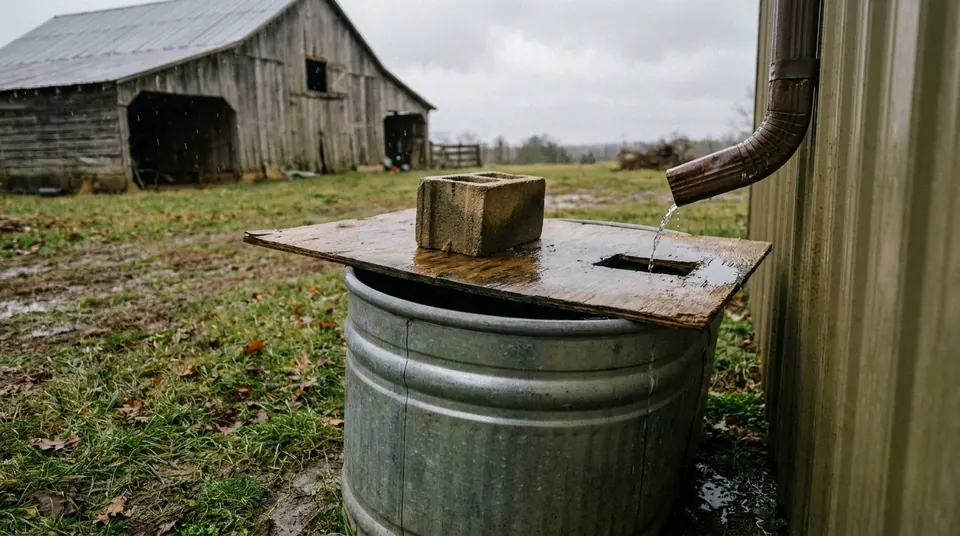
Stock tank vs rain barrel
People often ask about a rain barrel vs a stock tank. They do different jobs.
- Rain barrel: about 50-60 gallons, closed top, spigot at the bottom, fed from a downspout. It is made for garden use and it fills itself.
- Stock tank: bigger and cheaper per gallon, open top, no spigot. It works as a bulk reserve you fill on purpose.
You can run both. A stock tank under a downspout fills with every rain. That roof water is for flushing and for the garden. A tank you fill from the hose is your drinking reserve. Keep the two apart and label them.
Galvanized vs poly stock tanks
Two materials dominate the farm store.
Galvanized steel is the classic. It is tough, it does not crack in the cold, and it lasts for decades. It can rust at the seams and the rim over time, and it needs a cover you make yourself.
Poly (plastic) is lighter and cheaper. It does not rust. Sun can wear it down over the years, and in a hard freeze, any full tank can be damaged when ice forms. Drain or partly empty it if a deep freeze is coming.
Here is the part the label will not tell you. Stock tanks are sold for animals, and the farm store does not promise the water inside is fit for people. Tractor Supply’s own listings talk about livestock. None of that makes the water unsafe. It means you should not assume it is clean.
I could not find an extension service or a manufacturer that states a stock tank is food-grade. So here is the safe approach:
- Wash a new tank with dish soap and rinse it well.
- Sanitize it. Ready.gov’s method for home water containers is 1 teaspoon of unscented liquid bleach per quart of water, swished around the inside.
- Rinse again and fill.
- Treat all water before anyone drinks it. That is the rule that matters, and it applies to every tank, new or old.
If you want a tank that is built and labelled for drinking water, buy a food-grade water tank from a supplier that says so on the product page. A stock tank is the cheap option, and it needs one more step from you.
How to fill a stock tank
Before a storm
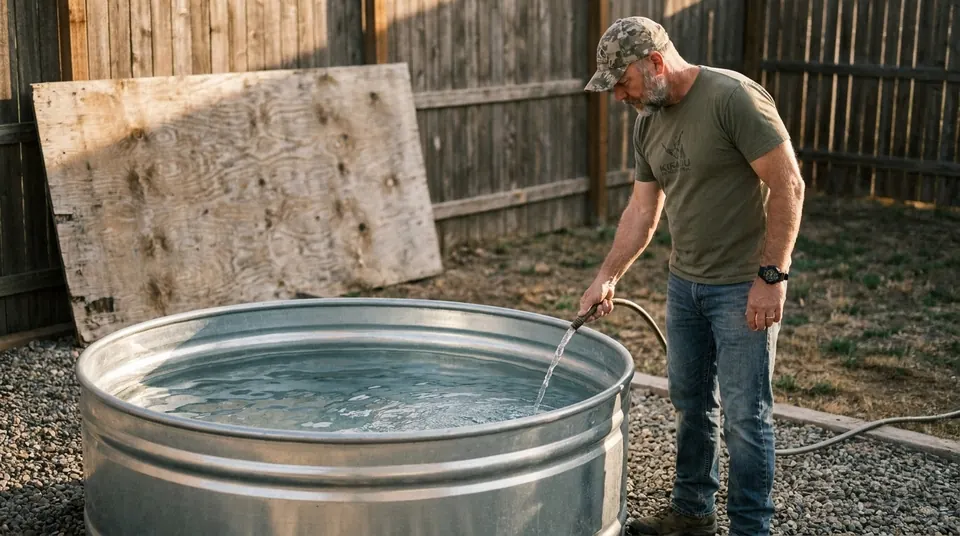
Fill it from the garden hose while the taps still run. Many towns warn people before the water goes off. A hose runs about 5-10 gallons a minute, so 100 gallons takes roughly 10-20 minutes. Treat that as a rule of thumb, because pressure varies.
Use a clean hose. A garden hose that has sat in the sun has been used for plants, not for drinking. Run it for a minute first. If you want to be careful, use a hose labelled drinking-water safe.
Under a downspout
A tank under a downspout fills on its own. Put a mesh screen over the top to keep out leaves, and use a cover with a gap just for the pipe. This water goes to the toilet and the garden.
Safety: Roof runoff picks up bird droppings, dust and shingle grit. Do not drink it untreated. Use it for flushing and watering, and filter and disinfect it if it ever has to be your only source.
Cover it
A cover does three jobs.
First, it keeps mosquitoes out. Open standing water in warm weather turns into a nursery quickly. Second, it keeps out leaves, dust and critters. Third, it protects the people who live there.
A tank full of water is a drowning risk for small children and for pets. A cover that only sits on top is not enough, because a child can lift it. Weigh it down with bricks or tie it off, and keep it locked in place if kids live nearby.
A sheet of plywood works. A tight lid with a latch is better. Window screen stretched over the opening keeps out mosquitoes if you must leave it ventilated, but it does not stop a child from falling in.
Where to put it: the weight rule
This is where people get surprised. A full 100-gallon tank is about 835 lb, plus the weight of the tank. That is a heavy load on a small footprint.
- Never on a deck, balcony or raised platform. Decks are rated for people and furniture, not a tonne of water.
- Put it on level ground or a slab. A bed of compacted gravel or paving stones works. Check it with a level.
- Choose the spot before you fill it. You cannot drag a full tank. If you must move it, drain it first.
- Keep it near the house, but off the foundation. An overflow spills water to the wall. Aim it away.
- Use shade where you can. Sun warms the water, and warm water grows algae and germs faster.
Safety: Water is the heaviest thing most people ever store. Put the tank where it will stay, on solid ground, before the first drop goes in.
Treat the water before you drink it
Do this every time, whether the water came from the hose or from the sky.
- Strain it. If it looks cloudy, let it settle and pour it through a coffee filter or a clean cloth. The EPA’s emergency disinfection page says disinfection works less well in cloudy or colored water.
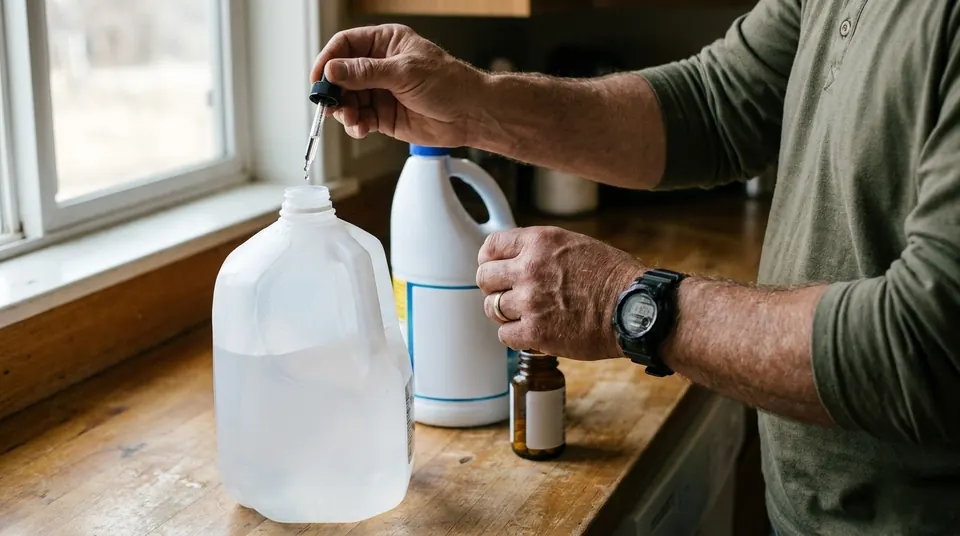
- Then boil or bleach it. - Boil: a rolling boil for at least 1 minute, and 3 minutes above 5,000 ft (EPA). Let it cool in a clean, covered container. - Bleach: use regular unscented bleach with 6% or 8.25% sodium hypochlorite. For 1 gallon, the EPA says 8 drops of 6% bleach, or 6 drops of 8.25%. Double the dose if the water is cloudy, colored or very cold. Stir, wait 30 minutes, and check for a faint chlorine smell. If there is none, dose again and wait 15 more minutes.
Ready.gov uses a slightly different bleach measure for the same job: 1/8 teaspoon per gallon of 5.25-6% bleach. Both are official, and both are close. Pick one, write it on the lid, and stick to it.
For a deeper look at the options, read iodine vs chlorine for water purification.
Note: Boiling and bleach do not remove fuel, pesticides or other chemicals. If the water smells of gasoline or chemicals, do not drink it.
Keep it clean and rotate it
Ready.gov says to replace water that was not commercially bottled every six months. A tank is no different, so make it a habit.
- Check the tank every few weeks. Look for green slime, leaves, dead insects or a funny smell.
- Scrub and sanitize it twice a year with the bleach method above.
- Draw water with a clean dipper or a bucket with a lid. Do not dunk cups or hands.
- Use the old water for the garden when you refresh the tank.
Keep a few bottles or jugs for drinking too, so you are not forced to open the tank on day one. The list in what sells out first in an emergency shows why a gallon jug is the first thing that vanishes.
Using stock tank water to flush a toilet
This is where a tank pays for itself. When the pipes dry up, a toilet turns into a very expensive chair. You can still flush it by pouring water into the bowl. About a bucket’s worth, 1-2 gallons, usually does it. Treat that as a rule of thumb, since toilets differ.
If you use treated drinking water for flushing, you will burn through it fast. Use tank water that came off the roof, or the old water you rotated out. Save the clean reserve for people.
A tank pairs well with other cheap farm-store buys. See the full list in Tractor Supply prepping items, where the stock tank is one of nine.
What to do this weekend
- Pick a spot: level, firm, near a hose, away from the house wall.
- Buy a tank of 100 gallons or more, and a cover or plywood.
- Wash and sanitize the tank. Fill it.
- Cover it and weigh it down.
- Write the treatment dose on the lid with a marker.
- Put a bucket and a dipper next to it.
- Put a date on your calendar six months out to refresh it.
Frequently asked questions
How much water does a 100-gallon stock tank hold?
A tank sold as 100 gallons holds about that much when filled to the brim. In practice you will get about 85-90 gallons without spilling. Water weighs 8.34 lb per gallon, so a brim-full tank is about 835 lb, before the weight of the tank itself.
Is it safe to store drinking water in a stock tank?
You can store it, but treat it before you drink it. Stock tanks are sold for livestock and are not labelled for drinking water. Wash and sanitize the tank, cover it, and then filter and boil or bleach the water, using the EPA’s doses.
How long can you store water in a stock tank?
Ready.gov says to replace water that is not commercially bottled every six months. In a covered, shaded tank, check it every few weeks. If it turns green, smells off or collects debris, dump it on the garden, scrub the tank and start again.
How many gallons of water does a family need?
FEMA and Ready.gov say at least 1 gallon per person per day, for drinking and sanitation. A family of four needs about 4 gallons a day, or 28 gallons a week. Hot weather, illness and nursing can double that.
Can I use a stock tank as a rain barrel?
Yes, but a stock tank has no spigot and an open top, so cover it. Roof runoff is not clean. Use it for flushing toilets and watering the garden, and treat it thoroughly if it must be used for drinking.
Sources
General information, not medical or professional advice. In an emergency, call 911 and follow official instructions. Disclaimer.