CHOWFood Storage
Rodent Proof Food Storage: Why a Galvanized Can Beats a Bucket
Mice and rats chew through paper, bags and plastic. A galvanized steel can with a tight lid stops them. Here is how to set one up and clean up safely.
 By Mike Dawson
10 min read
BLUFBottom line up front
Rodents chew through paper, bags and plastic, so put sealed food inside a galvanized steel can with a tight lid. Set it on a board off the concrete, strap the lid with a bungee, and seal gaps over 1/4 inch in the room. Throw out any food they reached.
- Rodent teeth never stop growing, so mice and rats gnaw on soft things all the time. Paper and plastic lose.
- Mice fit through gaps of about 1/4 inch and rats through about 1/2 inch. A dented can lid is an open door.
- Sealed bags or buckets go inside the steel can. The steel is the armor and the bag is the second wall.
- Droppings and urine can carry disease. Wet them with disinfectant, do not sweep or vacuum, and throw out food they touched.
- Garages are hard on food: heat and damp. Keep cans off the floor and as cool and dry as you can.
Draw list What to get, and why
| Item | Why | Rough cost |
|---|---|---|
| Galvanized steel trash can with tight lid | Rodents cannot chew through it, and the lid seals the top | About $25-50, by size |
| Bungee cords | Hold the lid on against raccoons and a dented rim | A few dollars |
| Scrap board or pallet | Lifts the can off damp concrete so the bottom does not rust | Free to a few dollars |
| Food-grade buckets with gasket lids, or mylar bags | The inner wall that keeps food sealed inside the can | About $5-12 per bucket |
| Steel wool or hardware cloth | Closes gaps in the storage room walls and doors | About $5-15 |
| Rubber gloves, disinfectant or bleach, paper towels | For a safe cleanup if rodents get in | About $10-15 |
Rather watch it?
I cover this in a video: 9 Cheap Items at Tractor Supply That Veterans Hoard Before Anyone Else.
Plays from YouTube when you click it.
A full pantry has one enemy most preppers forget about. It can chew straight through a plastic bucket.
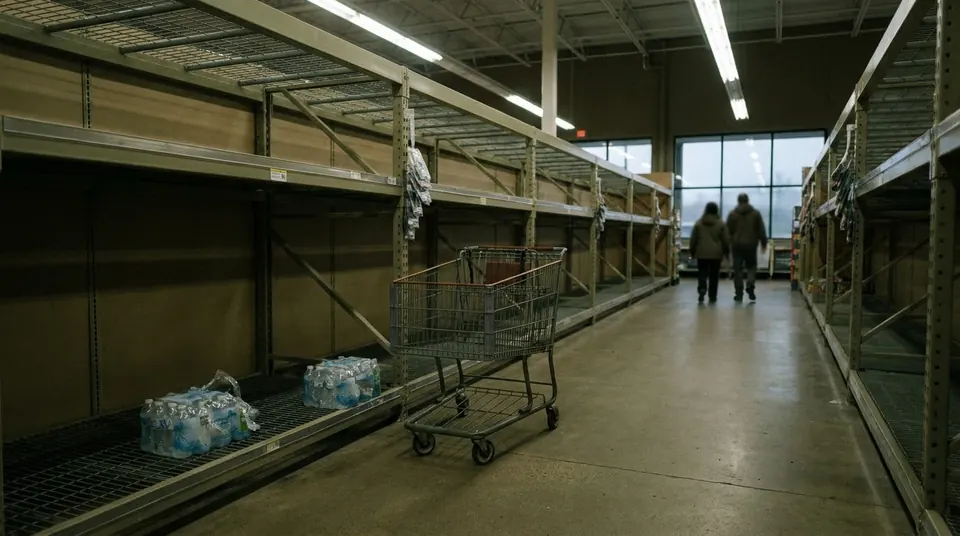
You can buy the food, rotate it and label it. Then one season of mice in the garage turns a sack of rice into a mess you cannot eat. When the store is empty, that is a month of meals gone, and nobody is restocking it. Rodent proof food storage is cheap insurance, and the best container for it is a plain galvanized steel trash can from the farm store.
This article covers why rodents chew, what they can get through, how to set up a steel can, the garage problem, and how to clean up safely if they get in.
Why rodents chew through almost everything
Rodent teeth never stop growing. Mice and rats gnaw on things to wear them down, so they chew on wood, wire, paper and plastic almost every day. Food is the reward that keeps them at it.
To a mouse, plastic is soft. A mouse can get through a paper feed sack in a single night. A rat that smells food on the other side of a plastic bucket will keep working at the rim or the lid until it is through. I could not find a lab number for how long that takes, so treat “overnight” as a rule of thumb for paper and thin bags, and “patient” for plastic.
Here is a rough guide to what holds and what fails:
| Container | Rodent-proof? | Notes |
|---|---|---|
| Paper or cloth sack | No | Chewed through in a night |
| Cardboard box | No | Same |
| Thin plastic bag | No | Easy to gnaw |
| Plastic bucket with a snap lid | Not reliably | A rat can work at the rim |
| Glass jar with a metal lid | Yes | Heavy, breakable, good for small amounts |
| #10 steel can | Yes | Sealed at the factory |
| Metal ammo can | Yes | Small, with a rubber gasket |
| Galvanized steel can with tight lid | Yes, if the lid fits | Best bulk option |
How small a gap can a mouse use?
Smaller than most people think. The Texas A&M extension service says a mouse can enter through a hole about the size of a dime, or a 1/4 inch crack, and a rat through a quarter-sized hole or a 1/2 inch gap. Other guides say to seal anything wider than 1/4 inch.
The CDC has also published coin comparisons for mice and rats, and the coins it names are different. So go by the inch measure, not the coin. If you can slide a pencil in, a mouse can probably follow.
That is why a dented lid on a trash can is an open door. Check the rim and the lid for dents, gaps and warping before you trust a can with your food.
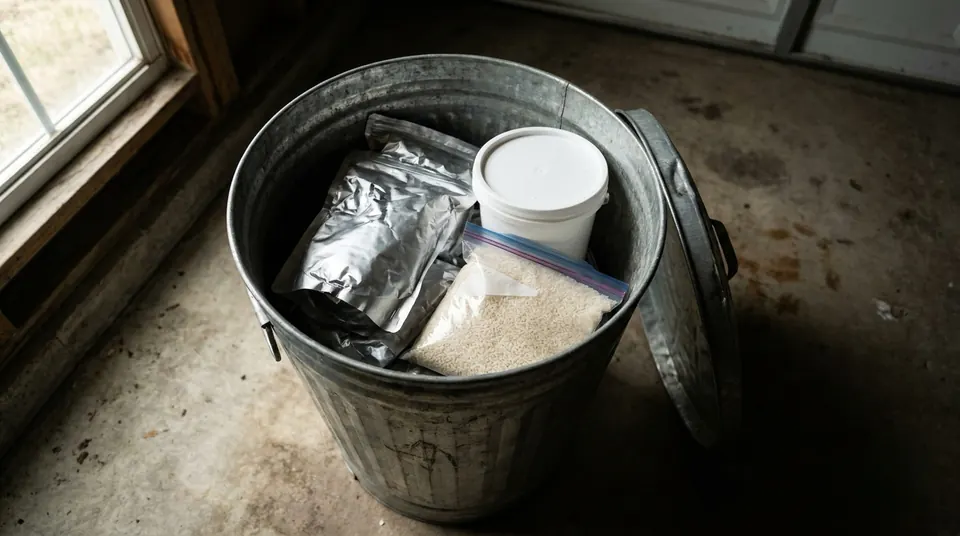
The galvanized steel can method
Walk past the feed room in any old barn and you will see a row of shiny metal cans with tight lids, full of grain and chicken feed. Farmers did not choose them for looks. They chose them because they lost enough feed to rodents to know what works.
Here is the setup.
1. Buy the right can
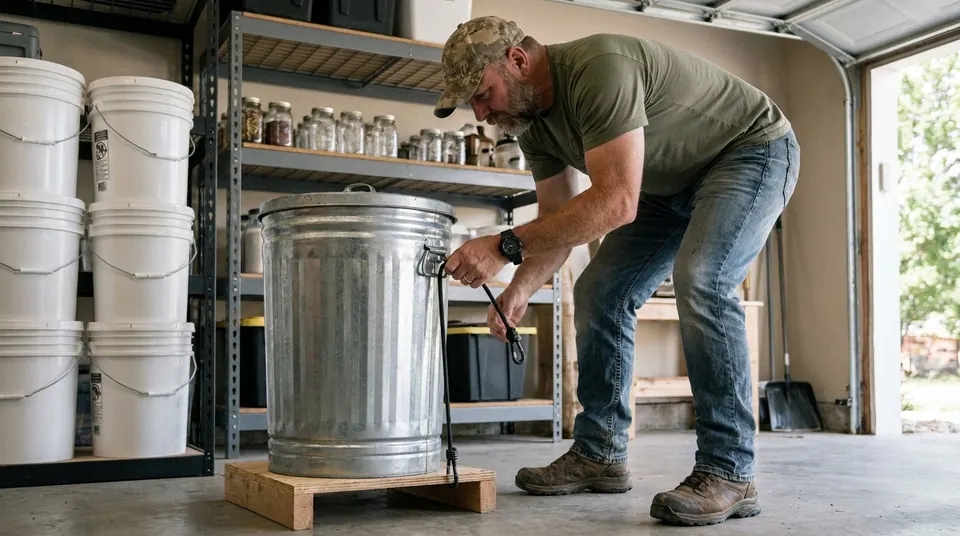
Look for a galvanized steel can with a lid that fits snugly all the way around. Test it at the store. Press the lid down. It should seat evenly, with no rocking and no gaps. Prices run roughly $25-50 depending on size. A 20-32 gallon can holds a lot of food.
2. Put food in sealed containers first
Do not pour loose rice into the can. Keep the food in its own sealed bags or smaller buckets, and put those inside. The steel is the armor, and the bags are the second wall. If a mouse ever gets in, the food is still sealed, and the can is easier to clean.
Food-grade buckets with gasket lids and mylar bags both work as the inner layer. My Tractor Supply prepping list covers other farm-store buys that go with this one.
3. Lift it off the concrete
Set the can on a board, a pallet or a couple of blocks. A damp floor wicks moisture into the bottom and rusts it out over the years. The lift also gives you a place to look under the can for droppings.
4. Strap the lid
Run a bungee cord over the top and hook it to both handles. This does two jobs. It keeps the lid seated even if the rim is a little dented, and it stops a raccoon from popping the lid. Raccoons are better with lids than most toddlers.
5. Keep it quiet
A metal can in the corner of a garage does not look like food storage to anyone glancing in. It looks like trash. In a long emergency, the pantry that looks like garbage is the pantry nobody tries to take.
Other rodent-proof options
A steel can is the best bulk choice, but it is not the only one.
- Glass jars with metal lids: good for beans, pasta and dry goods. Rodents cannot chew glass. Keep them off a shelf edge, because they break.
- #10 steel cans: the tall food-service cans. They are rodent-proof while sealed. Once you open one, move the rest into a jar.
- Metal ammo cans: with a good rubber gasket they hold small amounts of food well, and they stack.
- Canning jars: home-canned food in glass is safe from gnawing. If you are stocking lids, read my guide on whether you can reuse canning lids.
- Hard plastic buckets: fine inside a steel can or in a rodent-free room. On their own in a garage, they are a gamble.
The garage problem
Most people store food in the garage because that is where the space is. A garage is also where rodents live, because it is dark, has food scraps and has gaps under the door.
A garage has a second problem. Heat and moisture. A hot attic or garage shortens the life of canned and dry food, and damp rusts steel and ruins paper labels. Keep food cool and dry whenever you can. If the garage is the only place, then:
- keep cans and buckets off the floor;
- keep them away from the walls, where mice run along the edge;
- put the heat-sensitive things, like canned goods and lids, in the coolest corner;
- check the space every few weeks for droppings, gnaw marks and chewed paper.
A better spot is a closet or room inside the house, if you have one. Rodents can reach those too, but it is usually cooler and drier.
Seal the room, not just the food
Containers are the last line. The first line is keeping rodents out of the room.
- Walk the outside of the house. Look for gaps around pipes, vents, the foundation and the garage door. Seal anything bigger than 1/4 inch.
- Use the right filler. Steel wool or copper mesh stuffed into a gap, then sealed with caulk or foam, works. Rodents chew through foam and plain caulk alone. Hardware cloth works for vents.
- Fix the door. A gap under a garage door lets a mouse right in. A rubber door sweep closes it.
- Take away the food. Pet food, bird seed and spilled feed attract them. Store those in steel too.
- Set traps. Snap traps along the walls, with the trigger end against the wall. Check them every day.
Safety: Do not use poison baits in a space with kids, pets or stored food. A poisoned rodent can die in a wall, and pets can eat it.
When rodents get in: cleanup and what to throw out
Mice and rats leave droppings and urine in what they do not finish, and those can carry disease. The CDC links rodents to hantavirus, which is spread when dried droppings and nesting material are stirred up and breathed in. One visit can ruin a whole sack.
The CDC’s rodent cleanup guidance is clear on the method:
- Put on rubber or plastic gloves.
- Do not sweep or vacuum. That throws particles into the air.
- Spray the droppings and the area around them with a household disinfectant, or mix 1.5 cups of bleach per gallon of water (1 part bleach to 9 parts water). Make it fresh each time.
- Let it soak for about 5 minutes, or the time on the label.
- Wipe it up with paper towels and put them in a lidded bin that you empty often.
- Wipe hard surfaces with the disinfectant.
- Wash your gloved hands, take the gloves off, and wash your bare hands with soap and warm water.
For a heavy infestation, the CDC recommends added protection such as coveralls, boots, goggles and a respirator with a HEPA filter. If you are unsure, hire a pest professional.
Safety: Open the garage or room and let it air out before you start cleaning. If you feel sick with fever or breathing trouble in the weeks after cleaning up rodent droppings, tell your doctor about the exposure.
What to throw away
- Any food that a rodent reached, even if the bag looks fine.
- Any open container with droppings in it.
- Paper, cardboard and cloth that is soiled.
Food in an unopened can or an intact glass jar is a different case. Wipe the outside with disinfectant before you open it. When in doubt about a bag or box, throw it out. It is cheaper than a hospital visit.
The lesson behind the can
Army lesson: By the best known account, long before GI meant a soldier, army supply clerks used it for galvanized iron, the metal in cans like this one. Dictionaries trace the abbreviation to inventory lists for items such as trash cans and buckets, later read as “government issue”. The name started on the cans and ended up on the men. Historians still argue over the details, so take it as the best known account, not a certainty.
The point for your pantry is simple. Soldiers did not carry those cans for style. They used steel because it held up.
What to do this weekend
- Check what you store in plastic or paper, and move it into sealed bags or buckets.
- Buy a galvanized can with a tight lid. Test the fit.
- Set it on a board, load it, and strap the lid.
- Walk your garage or storage room and seal gaps over 1/4 inch.
- Put a note on your phone to check for droppings every few weeks.
- Add this to your shopping list: see what sells out first in an emergency before you stock up.
Frequently asked questions
Can mice chew through plastic buckets?
Yes, they can. Mouse and rat teeth never stop growing, so they gnaw on plastic to wear them down, and they will keep working at a rim or lid that smells like food. A thick bucket with a good lid slows them. Steel stops them. Keep buckets inside a steel can.
How small a hole can a mouse get through?
About 1/4 inch, roughly the size of a dime according to the Texas A&M extension service. Rats need about 1/2 inch, a quarter-sized hole. Seal gaps over 1/4 inch with steel wool, hardware cloth or sealant, because mice can chew through foam or caulk alone.
Is a galvanized trash can good for food storage?
Yes, as an outer layer. Steel keeps out rodents, and farmers have used it for feed for generations. Put food in sealed bags or buckets inside the can, because the can is not food-grade. Set it on a board, and strap the lid on.
How do you store food in a garage?
Use steel cans or sealed buckets. Keep them off the floor and away from the walls. Garages run hot and damp, which shortens shelf life, so put the most sensitive items in the coolest corner, check for droppings often, and rotate stock.
How do you clean up mouse droppings safely?
Wear gloves. Do not sweep or vacuum. Spray the droppings with disinfectant or a bleach mix of 1.5 cups per gallon of water, let it sit about 5 minutes, then wipe up with paper towels. Throw them in a lidded bin and wash your hands well.
Sources
General information, not medical or professional advice. In an emergency, call 911 and follow official instructions. Disclaimer.