Propane Exchange vs Refill: Why the Swap Tank Comes Up Short
Swap tanks hold about 15 lb of propane in a 20 lb cylinder. Here is what that costs you, when a refill wins, and how to store propane for emergencies.
 By Mike Dawson
10 min read
BLUFBottom line up front
Refilling is usually cheaper per pound. An exchange tank holds about 15 lb of propane, while your own 20 lb cylinder can take about 20 lb. At the same sticker price, refill gives you roughly a third more fuel. Propane itself does not go bad.
- Exchange cylinders are sold with about 15 lb of propane. A refill of a 20 lb cylinder takes about 20 lb.
- Refill is usually cheaper per pound. Ask if the station charges by the gallon or a flat fee.
- The date on the collar is the cylinder’s date, not the gas’s. First requalification is due 12 years after manufacture.
- Store tanks outdoors, upright and in the shade. Grills and camp stoves stay outdoors too, because of carbon monoxide.
- A 20 lb tank holds roughly 430,000 BTU. Use the runtime calculator to see how long that lasts.
Draw list What to get, and why
| Item | Why | Rough cost |
|---|---|---|
| Your own 20 lb cylinder (refillable, with OPD valve) | Takes about 20 lb on a refill, not 15 | About $30-60 new, or free from an exchange you already own |
| Second full 20 lb cylinder | A spare means no scramble when the first runs out | Same as above, plus about $15-20 to fill |
| Adapter hose for a camp stove | Runs a two-burner camp stove from a 20 lb tank, not 1 lb bottles | About $15-25 |
| Soapy water in a spray bottle | Leak check for the valve and fittings: bubbles mean a leak | Pennies |
| Battery-powered CO alarm | Backup near any room where fuel appliances run nearby | About $20-35 |
Rather watch it?
I cover this in a video: 9 Cheap Items at Tractor Supply That Veterans Hoard Before Anyone Else.
Plays from YouTube when you click it.
An exchange tank looks like a full 20 lb propane cylinder. It is not. A swap tank comes with about 15 lb of propane inside, and a refill of your own 20 lb cylinder takes about 20 lb. At a similar price, that gap shows up in your pocket and in how long your stove runs.
This matters more in a long outage, when propane is the fuel that cooks food and boils water. Here is the propane exchange vs refill comparison, with an example you can run with your own prices, plus the storage and safety rules that go with it.
How much propane is in an exchange tank?
About 15 lb, in a cylinder built to hold 20 lb. That is three quarters full.
It used to be more. In 2008, Blue Rhino and AmeriGas each cut the propane in their exchange tanks from 17 lb to 15 lb, without lowering the wholesale price, according to the Federal Trade Commission. The FTC said the two firms together controlled about 80 percent of the wholesale exchange market. It charged that they coordinated while negotiating with Walmart, which had resisted the change.
The companies settled in October 2014. The orders bar them from agreeing with competitors on fill levels or prices and require antitrust compliance programs. Ferrellgas, Blue Rhino’s parent, said it admitted no wrongdoing.
To be fair, the cut itself was not what the FTC charged. The complaint was about the companies working together on it. The result for you has not changed: swap tanks still come in at 15 lb.
Tip: Count what actually goes in the tank, not what the label implies. Ask the price per pound or per gallon before you pay.
Is it cheaper to refill or exchange propane?
Almost always, refill wins per pound. The reasons are simple. You get about 20 lb instead of 15, and a station that fills your own tank has no cage and no truck to pay for.
Here is the math. These are example prices, not quotes. Prices change by store and by season, so swap in the ones near you.
| Exchange | Refill (by the gallon) | Refill (flat fee) | |
|---|---|---|---|
| Price paid | $22 | $3.50 per gallon | $20 |
| Propane received | 15 lb | 20 lb (about 4.8 gal) | 20 lb |
| Total cost | $22 | about $17 | $20 |
| Cost per pound | about $1.47 | about $0.83 | $1.00 |
A gallon of propane weighs about 4.2 lb at 60°F (15.6°C), which is how 20 lb works out to about 4.8 gallons. That is a standard industry figure, and it shifts a little with temperature.
Even a flat-fee refill beats the swap in this example. The exchange costs you more and gives you a third less fuel.
The catch
An exchange has real advantages, and they are worth stating:
- It is fast. You hand over an empty and walk out with a full tank.
- The exchange company handles the date check on the cylinder. With a refill, you must watch it yourself.
- Cages sit outside grocery stores and gas stations at all hours.
A refill is cheaper, but it takes a few minutes and a stop at the right place.
Where to refill propane
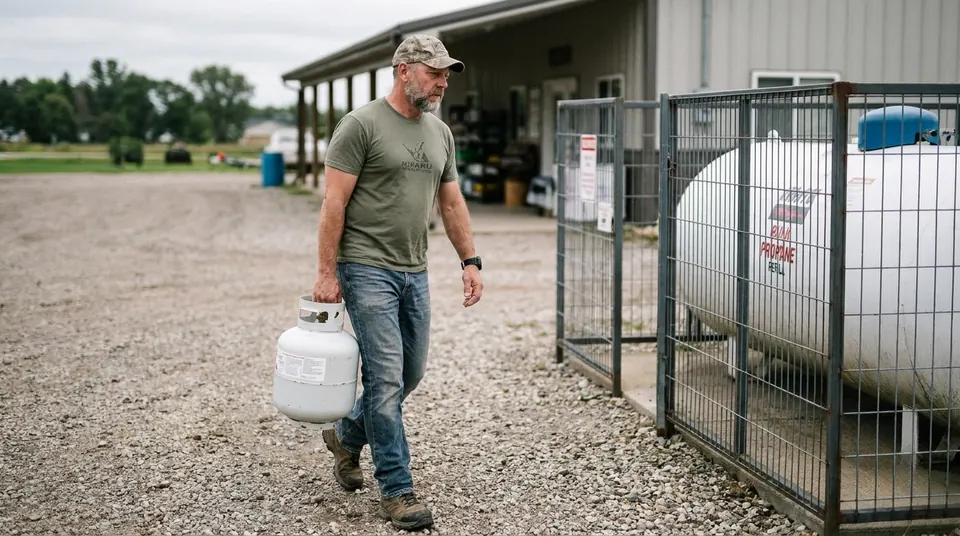
- Tractor Supply. Many stores refill 20 lb cylinders at a counter. Call first, because it is not every store.
- Propane dealers and farm co-ops. These often have the lowest per-gallon prices.
- Some big-box and hardware stores, and truck rental lots. Policies vary.
Whatever the place, ask one question first: do you charge by the gallon or a flat fee per tank? A per-gallon station only charges for what goes in. A flat-fee station charges the same for a nearly full tank as for an empty one, so run a tank down before you refill.
Station staff fill your cylinder by weight, using the tare weight (marked TW) stamped on the collar. A cylinder with an overfill prevention device (OPD) valve will stop at its safe limit, about 80 percent of the cylinder’s volume, which leaves room for the liquid to expand. Per Maryland’s environment department, the OPD requirement came into force in 1998 for new cylinders, and refilling of cylinders without one was no longer allowed from April 2002.
Does propane go bad? How long does it last in storage?
No. Propane sealed in a cylinder does not spoil. Gasoline goes stale in months and diesel can grow gunk. Propane is chemically stable. Note that most of the sources for this are propane suppliers, so it is industry messaging, though it matches the chemistry.
What limits the life of your supply is the cylinder, not the gas. That brings us to the date stamp.
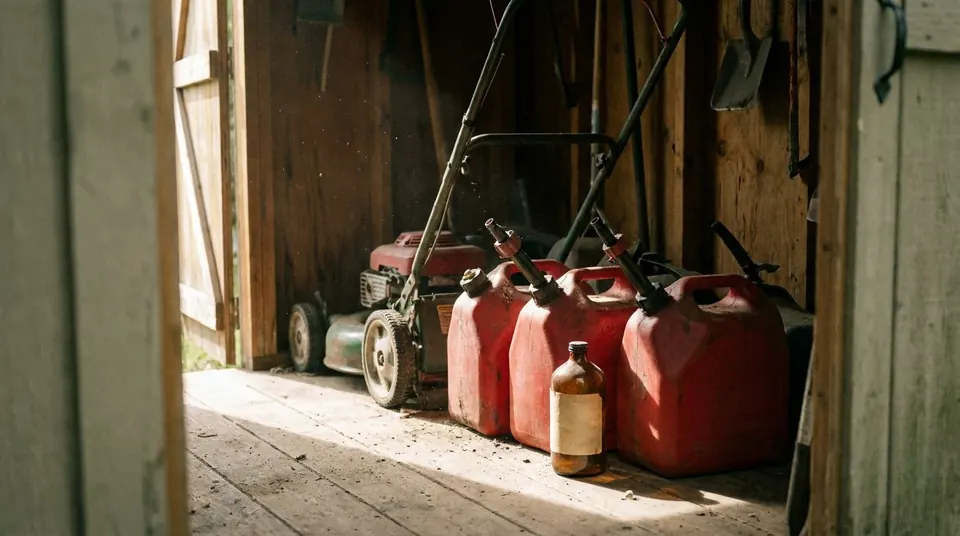
If you also store gasoline, see how it compares in my guide on how to store gasoline long term.
Propane tank expiration date: what the collar stamp means
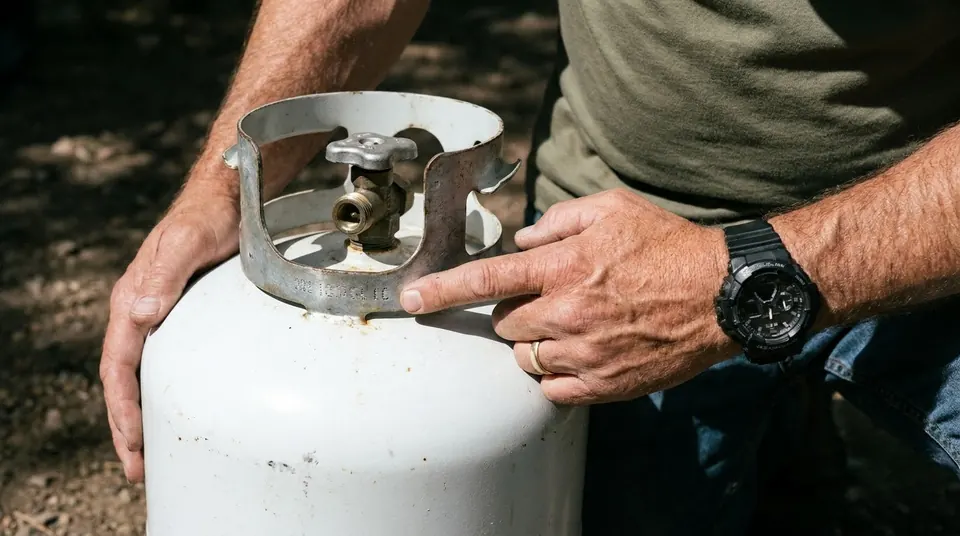
Look at the metal collar around the valve. There is a date stamped in it, in a month and year form such as 05-19. That is when the cylinder was made.
The rule, per the Department of Transportation’s pipeline safety agency, PHMSA:
- A cylinder must be requalified within 12 years of its manufacture date.
- After a retest, the next due date depends on the test method. A visual retest is commonly good for 5 years, and some methods allow longer.
- An overdue cylinder cannot legally be refilled.
Requalification means a trained shop inspects the cylinder and stamps a new date next to the old one. A cylinder that fails is taken out of service.
So the “expiration date” is about the steel, not the fuel. It also means a tank in your garage can be a problem on the one day you need it. Check the date now, on a quiet afternoon, not in a line of people in the middle of an outage. The exchange cage handles this for you, which is one real reason to keep an exchange tank as a spare.
Note: Rules on intervals changed in recent years, and the stamps use letter codes. If you are unsure, ask the station or a propane dealer to read the collar, or check the current federal rule (49 CFR 180.209).
How to store propane for emergencies
Propane is heavier than air. A leak sinks and pools in low spots, so where the tank sits matters.
- Outdoors. Keep tanks outside, never inside the house, a basement or a closed garage.
- Upright. A tank on its side can leak from the valve, especially when full.
- In the shade. Keep it out of direct sun and away from heat sources, on a firm and level surface.
- Not in a closed box. A sealed deck box or bin can trap a leak the way a garage does.
- Capped and closed. Close the valve tight when not in use.
Local fire codes can limit how many tanks you may keep and where. Check with your fire department if you plan to store more than a couple.
Safety: Grills and camp stoves stay outdoors every time. They make carbon monoxide, which can kill you in a closed space. The CDC says never to use a portable camping stove or grill inside a home, tent or camper, and never in a garage. Keep a battery-powered CO alarm in the house.
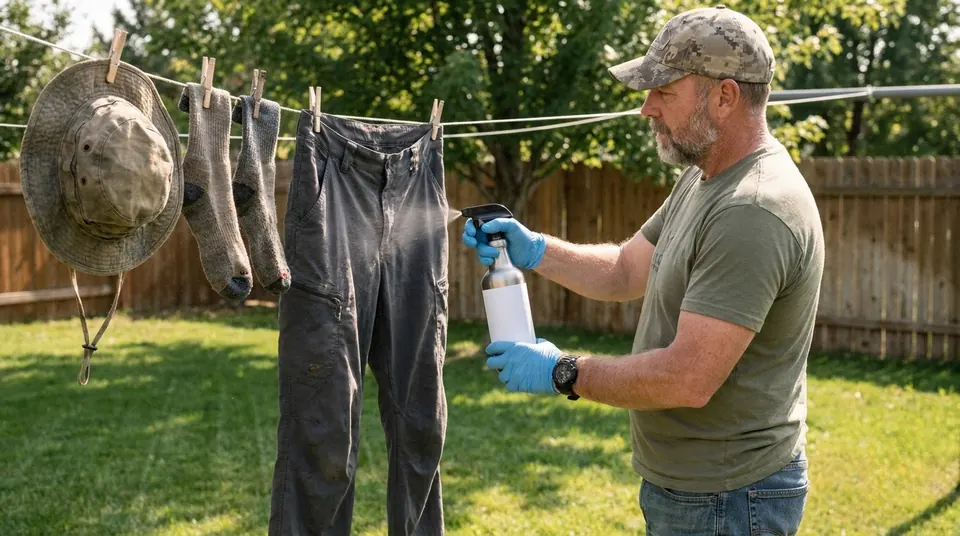
Do a leak check each season. Brush soapy water on the valve and hose fittings and open the valve. Growing bubbles mean a leak. Close the valve and have it checked.
Cooking from a 20 lb tank: adapter hose vs 1 lb bottles
Most camp stoves run on small green 1 lb bottles. They are handy and they are the most expensive way to buy propane. Using the same example prices, a $5 bottle holds 1 lb, which is $5 per pound, against about $0.83-$1.47 per pound for a 20 lb tank.
An adapter hose connects a camp stove to a 20 lb cylinder. This is a common setup for a family. Rules to follow:
- Use it only outdoors, as you would any camp stove.
- Use only a hose and regulator rated for your stove, and read the stove’s manual first.
- Set the cylinder upright on a level spot, with the hose clear of the burners.
- Check connections with soapy water.
A tank of this size and a stove can cook for a family for a long time. If you are building a farm-store kit, this is item 5 on my Tractor Supply prepping items list.
How long does a 20 lb propane tank last?
Propane holds roughly 21,500 BTU per pound, about 91,500 BTU per gallon, according to AmeriGas. So:
- A 20 lb cylinder holds about 430,000 BTU.
- A 15 lb exchange cylinder holds about 322,000 BTU.
Divide by the burner rating to get hours. As a rough example, a camp stove burner rated at 10,000 BTU per hour, run flat out, would use a 20 lb tank in about 43 hours. A grill running at 30,000 BTU per hour would use it in about 14. Real use is lower, because you do not run full blast all day.
For your own appliances, use the propane runtime calculator. It gives hours and days for a stove, heater or grill.
Propane is one of three fuels worth thinking about for a blackout. Another is lamp fuel, covered in my guide on kerosene lantern safety. Propane tanks also appear on my list of what sells out first in an emergency, where small bottles go first.
What to do this weekend
- Find the date on every cylinder collar. Note any that are near 12 years old.
- Call two places to ask the refill price and whether it is per gallon or flat.
- Refill, do not swap, your next empty.
- Buy a second 20 lb cylinder and fill it.
- Check that every tank is stored outdoors, upright and in the shade.
- Do a soapy water leak check on each valve and hose.
- Run your stove’s BTU rating through the calculator.
Frequently asked questions
Is it cheaper to refill or exchange propane?
Refilling is usually cheaper per pound. An exchange tank holds about 15 lb, and your own 20 lb cylinder takes about 20 lb on a refill. In the example above, the exchange comes to about $1.47 per pound and a refill about $0.83 to $1.00. Prices vary, so call your local stations.
How much propane is in an exchange tank?
About 15 lb, in a cylinder built for 20 lb. In 2008, Blue Rhino and AmeriGas each cut exchange tanks from 17 lb to 15 lb, as the FTC described in its 2014 case. A refill of a 20 lb cylinder takes about 20 lb, so you get roughly a third more fuel.
Does propane go bad?
No. Propane sealed in a cylinder is chemically stable and does not spoil the way gasoline does. The part with an expiration date is the cylinder, which must be requalified 12 years after manufacture, then again on a schedule set by the test method. Check the date on the collar.
How long does propane last in storage?
The propane itself keeps indefinitely in a sealed cylinder. The limit is the tank: 12 years from the manufacture date for the first requalification, then a retest. Store tanks outdoors, upright and in the shade, and check them for leaks each season with soapy water.
What is the date on a propane tank?
It is the cylinder’s manufacture date, stamped on the collar as month and year, such as 05-19. A retest date may be stamped next to it. It tells you when the cylinder needs inspection, not when the propane goes bad. An overdue cylinder cannot legally be refilled.
Can you use a 20 lb propane tank on a camp stove?
Yes, with a rated adapter hose and regulator that fits your stove, used outdoors only. A 20 lb tank costs much less per pound than 1 lb bottles. Read your stove’s manual, keep the cylinder upright and check connections with soapy water. Never run a camp stove indoors.
Sources
- FTC: Blue Rhino, AmeriGas Settle FTC Charges of Restraining Competition (Oct. 2014)
- PHMSA: Is Your Cylinder Safe to Fill?
- Maryland Dept. of the Environment: Propane Cylinder Recycling fact sheet (OPD dates)
- AmeriGas: Propane BTU 101
- CDC: What to Do to Protect Yourself During a Power Outage
- Ferrellgas: Propane’s shelf life
General information, not medical or professional advice. In an emergency, call 911 and follow official instructions. Disclaimer.