SUPSupply Runs
What to Buy at an Army Surplus Store: 11 Items Veterans Pick
What to buy at an army surplus store: 11 boring items veterans pick, from wool socks to tourniquets, plus how to judge used gear and what to skip.
 By Mike Dawson
13 min read
BLUFBottom line up front
Skip the camo and buy gear that protects your body: wool boot socks, glove liners with leather shells, a Gore-Tex parka, ballistic eyewear, permethrin-treated clothing, and sealed medical items like a SAM splint, chest seals, Israeli bandages, hemostatic gauze and a real tourniquet.
- Surplus pays off on protection gear: dry feet, warm hands, rain shell, eye protection, bug protection.
- Medical items are worth buying only sealed, in date, from a source you can name. Fake tourniquets exist.
- Check seams and seam tape on used rain gear, and the fiber list on socks.
- Skip camo for looks, loose tourniquets and expired medical items you plan to rely on.
- Buy one extra of the cheap things that wear out, like socks and liners.
Draw list What to get, and why
| Item | Why | Rough cost |
|---|---|---|
| Wool boot socks, 4 or more pairs | Insulate when damp and cushion long walks | A few dollars to about $15 a pair |
| Wool glove liners plus leather shells | Warm fingers that still work; shells take the abuse | About $5-10 liners, $15-30 shells |
| Used Gore-Tex parka and trousers | Waterproof and breathable for cold rain | Roughly $40-120 depending on condition |
| Ballistic eyewear, clear and dark lenses | Holds together against flying chips | About $30-100 |
| SAM splint | Light, moldable splint for arms and legs | About $10-20 |
| Vented chest seals (pair) | Cover an open chest wound front and back | About $15-30 a pair |
| Israeli bandage, sealed | Pad plus built-in pressure bar | About $8-20 |
| Real tourniquet, sealed, from a named seller | Stops life-threatening limb bleeding | About $27-40 for a genuine CAT |
Rather watch it?
I cover this in a video: 11 Things Veterans Buy at an Army Surplus Store That Civilians Ignore.
Plays from YouTube when you click it.
This is medical information, not medical care or training. Take a hands-on class and get real care for serious injuries.
Walk into any army surplus store and most people head for the camo jackets and ammo cans. Veterans walk past them to the wool socks and the plain packs of field dressings. Knowing what to buy at an army surplus store comes down to one idea: buy what protects the one piece of equipment you can’t replace, which is you.
What soldiers use looks boring, and that is the point. Dry feet, warm hands, clear eyes, a stopped bleed. None of it looks cool in a photo. All of it works when the grid is down and the nearest ER is far away.
Below are 11 items, counted down from the cheapest to the one you must check hardest. After that: how to judge used gear, what to skip, and a table you can print and take to the store.
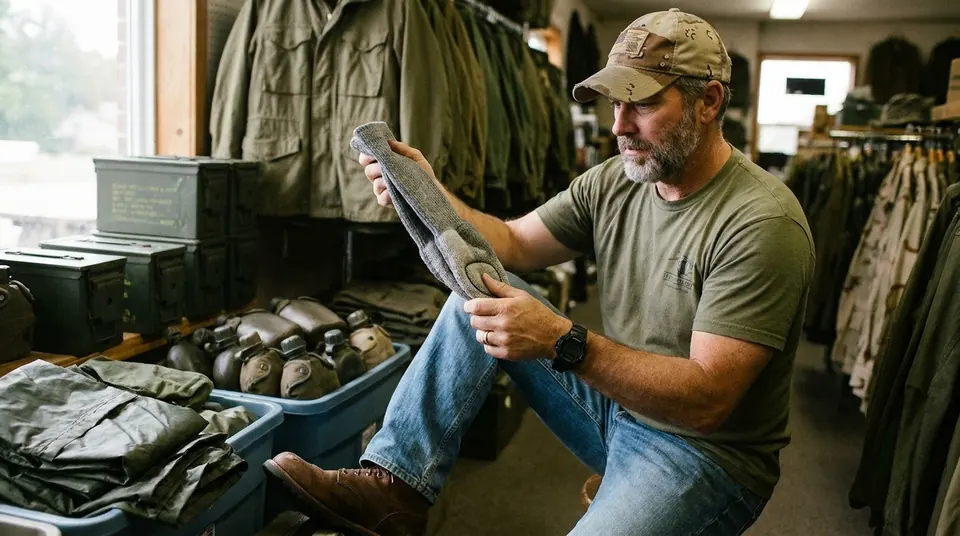
11. Wool boot socks
The cheapest thing in the store may matter most. In the winter of 1944-45, cold injuries (frostbite, trench foot and related conditions) took tens of thousands of US soldiers out of the fight in the European theater. The Army’s own history puts the total at roughly 71,000, mostly that winter. Many of those men sat in wet boots for days. The full story is in my guide to how to prevent trench foot.
Wool keeps insulating when it is damp. Cotton soaks up sweat and holds it against the skin. A wet cotton sock in a cold boot is a cold compress you wear all day, and it rubs blisters faster than almost anything.
Here is the habit soldiers are taught. Change your socks daily, even when you are tired. Tuck the wet pair inside your shirt, flat against your belly, and let your body dry it. You wake up with a dry pair.
What to check: the fiber label. Fibers are listed biggest share first, so wool should lead. Surplus bins mix in cotton and thin dress socks. Look for a thick cushioned sole, and buy more pairs than you think you need. Heels wear out first.
Army lesson: The Army’s own history of the winter of 1944-45 calls the cold injury losses avoidable. Wet feet are a supply problem long before they are a medical one. Check the Army history on cold injury, linked in the sources.
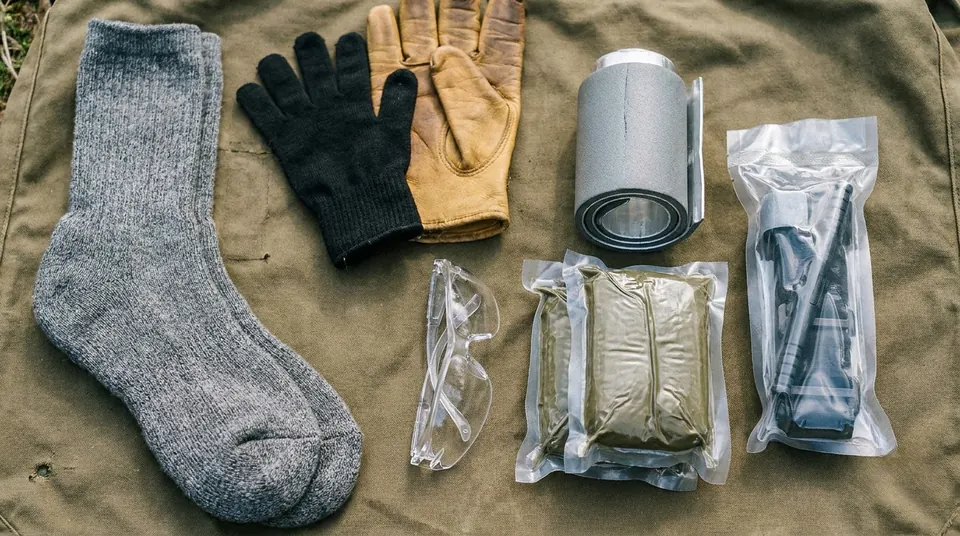
10. Wool glove liners and leather shells
Two thin layers beat one thick glove. The liner is wool. It keeps your fingers warm and still lets you tie a knot or work a zipper. The leather shell goes over it and takes wind and scraping.
When a job needs fingers, the shell comes off and the liner stays on. When liners get damp, swap in a dry pair kept in an inside pocket.
Safety: In deep cold, fuel on bare skin can freeze it fast. Gasoline pulls heat out as it evaporates, and cold-weather safety guidance warns against bare skin contact with fuel. If you refill a generator or stove in a hard freeze, keep your hands covered. If fuel soaks a glove, take the glove off and swap it.
Fancy ski gloves tear up on wood splitting and branch hauling. Leather shells were made for that. Buy a few pairs of liners, since they are cheap and they are the part that gets wet. Buy shells a little roomy. A tight glove squeezes blood out of your fingers, and cold fingers follow.
9. Gore-Tex parka and trousers
Soldiers are taught to respect cold rain more than deep cold. A dry freeze is easy to dress for. A cold, windy rain gets into everything and pulls heat out of every wet layer.
The older military Gore-Tex parkas end up on surplus racks because the Army moved on to newer versions. They are waterproof but breathable, so sweat from hauling and digging escapes. The hood is big enough to fit over a hat.
Why it matters in an outage: today a soaked jacket goes in the dryer. In a long outage it stays soaked overnight and the house is cold too. Staying dry becomes the whole game. Buy the matching trousers. Wet jeans are one of the fastest ways to get cold.
What to check on a used one:
- Turn it inside out and look at the seam tape. On older parkas it can peel.
- Run your fingers over the shoulders and hood, where rain hits hardest.
- Check zippers and the hood drawcords.
- Smell it. Heavy mildew means stored wet.
A used parka with good seams beats a new cheap one. Outdoor brands charge far more for the same idea with a nicer logo.
8. Ballistic eyewear
These look like ordinary sunglasses. They are tested against small, fast fragments that shatter normal lenses. Soldiers wear them because so much of what flies around them is small and fast.
At home, the jobs are different but the chips are the same: chopping wood, cutting fallen limbs, running a grinder, shooting. With no ER open, a scratched eye can turn into an infection, and no store sells a spare eye.
The Army keeps an Authorized Protective Eyewear List, called APEL. Pairs that meet the military ballistic standard say so on the frame or packaging, and you can check the model against the list before you pay. Be careful: an ANSI Z87.1 mark alone does not mean a pair meets the military test. Details are on the Oakley APEL page, a manufacturer page, so check the Army list itself too.
Get clear lenses as well as dark. Clear is what you will wear in a dim garage. Keep a pair by the wood pile and one in the truck. Make it a house rule: nobody splits wood or runs a saw bare-eyed, kids included.
7. Permethrin-treated uniforms
Permethrin is an insecticide that soaks into fabric. Ticks and mosquitoes that land on treated cloth are knocked down or killed. The Army has treated uniforms at the factory since the early 2010s, and treated clothing is one half of the DoD Insect Repellent System. Skin repellent is the other half.
Bugs have wrecked armies. Malaria was a huge problem in the Pacific in World War II. Military planners estimated it took at least 3, possibly as many as 5, divisions to keep one division in contact, because of malaria casualties. (A famous line credited to General MacArthur says much the same, but I could not trace it to a primary source, so I leave it out as a quote.)
Why it matters after a collapse: county spraying stops, gutters fill with standing water, and mosquitoes return. Ticks wait in the tall grass you walk through to haul water and gather wood.
What to check: the tag. Not every uniform on the rack was treated, and an untreated one is just a shirt. Do not dry-clean treated clothing, since that removes the permethrin. Wash treated items separately. My full guide is how to treat clothes with permethrin.
Safety: Permethrin goes on clothes, never on skin. Skin gets an EPA-registered repellent such as DEET, picaridin or IR3535. Keep cats away from wet permethrin until it is fully dry.
6. SAM splint
A SAM splint is a thin sheet of soft aluminum between layers of foam. It rolls up small and molds to almost any arm or leg. A surgeon named Sam Scheinberg is credited with the design, and medics and ambulance crews carry it.
Straight out of the package it is floppy, so people write it off as junk. Bend it lengthwise into a gentle curve, like a rain gutter, and it turns stiff. Shape it on the good limb first, then move it to the hurt one.
The basic rule: splint the joint above and below the break. For a broken forearm, the wrist and elbow both get held still. Wrap it snug, not tight, and keep checking fingers or toes. If they go pale or cold, loosen it.
Splinting has a real history. Early in World War I, a broken thigh bone killed roughly 4 in 5 of the men who had one, by some accounts. After the Thomas splint became standard in 1917, the rate dropped to under 1 in 5 in reported series, though better surgery helped too.
To be fair, a SAM won’t replace a traction splint for a thigh, and a badly bent bone still needs a doctor. For a wrist or ankle it is about the best thing you can carry. You can cut it to size with scissors.
5. Hypothermia prevention kit, not just a foil blanket
Cold is a medical problem even in a hot place. A body that loses blood loses its heat. A cold body clots worse, so bleeding gets worse, which makes it colder. Trauma teams call this cycle the lethal triad, and cold is the part you can fight with a blanket.
The military kit pairs a self-heating liner with a heat-reflective shell that wraps the patient like a sleeping bag with a hood. It needs no fire and no power. The kit is sold by North American Rescue as the HPMK. The heating liner works once, so check the date and keep the package sealed.
A foil emergency blanket alone blocks wind and holds in heat that is already there. It adds no heat. A person in shock has little heat to hold. It is better than nothing, but it is not the same thing.
Get the patient off the cold ground first. The ground pulls heat out faster than air. A sleeping pad, a folded coat or flattened cardboard all work. Keep them off frozen dirt even under a perfect blanket.
4. Vented chest seal
An open chest wound can suck air into the chest with each breath. The air gets trapped outside the lung and presses on it. A vented seal lets trapped air out and blocks air coming in, like a one-way door. Military trauma guidelines have called for the vented kind since 2013. The change is described in this TCCC guideline change.
How it works in plain terms: wipe blood off the skin so the patch grips, press it flat over the hole, and seal every hole, front and back. Then watch breathing closely. If it keeps getting harder, that person needs trained help fast. A seal only buys time.
For a prepper the likely cause is not a gunshot. It is a fall onto a fence post or a broken branch while clearing storm damage. Most household first aid lists have bandages and headache pills and nothing for this.
Buy them in pairs, for the front-and-back rule. Heat ruins the adhesive, so don’t leave them in a hot car. A seal that won’t stick is a sticker.
3. Israeli bandage
An Israeli bandage is a sterile pad sewn to an elastic wrap with a plastic pressure bar beside the pad. Bernard Bar-Natan, a former Israeli military medic, designed it. The US military adopted it in the early 2000s. It now sits in trauma kits from police cars to hunting packs.
A normal bandage covers a wound. Serious bleeding needs pressure. The bar builds the pressure in: wrap once, feed the wrap through the bar, reverse direction and keep wrapping. The bar presses down on the pad and locks it. A clip holds the tail. You can put it on one-handed, even on yourself.
It is also a better bandage for everyday ugly cuts, like a slipped saw. Buy it sealed, from a source you can name, because knock-offs exist. Get two sizes if you can. Full steps are in my Israeli bandage guide. For cleaning a wound afterward, see how to clean a wound.
2. Kaolin hemostatic gauze
Some wounds are too deep to press from outside, like the groin or armpit. Early in the Iraq and Afghanistan wars, medics used a clotting granule that could get hot enough to burn. The kaolin-treated gauze replaced it, and researchers at UC Santa Barbara reported it worked as well without the large heat release. The exact year of the switch varies by source. The common account is about 2008.
How it is used: pack it tightly into the wound toward the source of bleeding, keep feeding it in until the wound is full, then hold hard pressure with both hands for several minutes. Follow the package instructions, and don’t peek.
Plain gauze, packed well, beats nothing. The clay helps, but packing and pressure do most of the work.
The surplus move: expired packs are cheap, so buy one to practice packing. Keep a pack that is still in date, sealed, in your kit.
1. Tourniquet (real, not fake)
For an arm or leg that is pouring blood, nothing works faster. That is also why fakes are dangerous.
Cheap copies sell online and sometimes sit on surplus shelves next to real ones. A New Hampshire EMS bulletin described the windlass snapping on a suspected counterfeit during use. The maker has its own notes on this in a North American Rescue post. Genuine units run roughly $27-40, and a price far below $20 is a warning sign.
At a surplus store, buy one only if it is still sealed in the maker’s packaging. Leave every loose one in the bin, however new it looks. Elsewhere, buy from a seller listed on the maker’s own website. My full guide: how to spot a fake tourniquet.
Then buy a second one as a trainer. The real one stays new for the day it counts. Place it 2-3 inches above the wound, tighten until the bleeding stops, and note the time. It hurts, and that is expected. Take a Stop the Bleed class, which is short and often free.
Army lesson: A study of US combat deaths from 2001 to 2011 found that about 91% of potentially survivable deaths were from hemorrhage. Many of those men died before reaching a surgeon, with medics and helicopters close by. At home you have neither. Source: Eastridge et al., 2012.
How to judge used surplus
- Seams: turn rain gear inside out and check the tape.
- Zippers, snaps, hook-and-loop: work every one.
- Smell: mildew means damp storage. Mothballs wash out, mold does not.
- Sealed packaging: medical items should be factory sealed with no tears or sun fading.
- Expiry dates: read them. Dates are printed on the package.
- Fiber labels: read them on socks and base layers.
- Seller: ask where medical stock came from. A good store can tell you.
What to skip
- Camo for looks. It does not protect you from anything.
- Expired medical items for your real kit. Fine for practice, not for the day you need it.
- Loose tourniquets. Unsealed and unknown.
- Worn-out boots and thin socks. Foot gear is where cheap costs you.
- Anything that smells of fuel or mildew.
Surplus buying table
| Item | Why soldiers use it | What to check before you pay |
|---|---|---|
| Wool boot socks | Insulate when damp, cushion walking | Wool listed first, thick sole, no cotton mix |
| Glove liners and leather shells | Warm and nimble, tough over the top | Spare liners, shells slightly roomy |
| Gore-Tex parka and trousers | Waterproof, breathable, big hood | Seam tape, shoulders, zippers |
| Ballistic eyewear | Survives fast fragments | APEL listing, clear and dark lenses |
| Permethrin-treated uniform | Repels ticks and mosquitoes | Factory tag |
| SAM splint | Light, moldable limb splint | Intact foam, no kinks |
| Hypothermia kit | Adds heat, not just reflection | Sealed, in date |
| Vented chest seal | One-way seal for chest wounds | Pairs, sealed, no heat damage |
| Israeli bandage | Pressure dressing in one wrap | Sealed, from a named source |
| Kaolin gauze | Packs deep wounds | Sealed, in date |
| Tourniquet | Stops limb bleeding | Sealed in maker packaging only |
Frequently asked questions
Is army surplus worth it for preppers?
Yes for protection gear: wool socks, glove liners, rain shells, eyewear. Check condition, and don’t pay extra for looks. For medical items, buy sealed, in date, from a source you can name.
What are the best army surplus items for beginners?
Start with wool socks, glove liners with leather shells, a used Gore-Tex parka, and ballistic eyewear. They are cheap and protect your feet, hands, body and eyes. Add medical gear after you take a class.
Is it safe to buy expired medical supplies?
For practice, yes. For your real kit, no. Expired items may not work as designed. Buy in-date, sealed items for emergencies, and use expired ones to rehearse.
How can I tell if a tourniquet is fake?
Warning signs are a loose, unsealed unit, a price far under what genuine ones cost, poor print, and a flexible windlass. Buy sealed from a seller listed on the maker’s website.
Does surplus clothing come treated with permethrin?
Some does. Factory-treated uniforms carry a tag. Not every uniform is treated, so check the tag. Do not dry-clean treated clothing, and keep it away from cats while wet.
What to do this weekend
- Check your boots and socks. Replace cotton with wool.
- Buy 2 pairs of glove liners and one set of leather shells.
- Put ballistic eyewear by the wood pile.
- Sign up for a Stop the Bleed class.
- Buy a sealed Israeli bandage and a sealed tourniquet. Add a trainer.
- Read my guides on trench foot and permethrin.
Sources
- Eastridge et al., Death on the battlefield 2001-2011 (J Trauma Acute Care Surg, 2012)
- Army cold injury, European theater 1944-45 (Army history)
- Military Health System, malaria in WWII (MSMR)
- EPA, repellent-treated clothing
- TCCC guideline change 13-02, open pneumothorax
- UC Santa Barbara, kaolin hemostatic gauze
- NH EMS bulletin on counterfeit CAT tourniquets
- North American Rescue, counterfeit CAT post
- Emergency Bandage (history and design)
- Science Museum, Thomas splint
General information, not medical or professional advice. In an emergency, call 911 and follow official instructions. Disclaimer.